
Everything You Need to Know About Goals
An exclusive excerpt from "The Way of Excellence"


Today I am going to do something special: get you covered for the turn of the year by going deep on goals, with an exclusive excerpt from my forthcoming book, The Way of Excellence. I’m confident you’ll find it valuable, regardless of what you do or where you are on your path.
Chapter 5: Goals
Every climber desires to reach the peak of a mountain, but every climber spends 99.99 percent of their time, energy, and attention on its sides. “To live only for some future goal is shallow,” writes Robert M. Pirsig. “It’s the sides of the mountain which sustain life, not the top. Here’s where things grow. But of course, without the top you can’t have any sides. It’s the top that defines the sides.”
Goals are like mountaintops. They are important insofar as they provide definition and direction for our journeys. They serve as targets, offering a wellspring of motivation. They keep us focused and prevent us from aimlessly wandering. Yet nearly all of our growth, development, and meaning occur not at the point of accomplishing a goal but during its pursuit.
Imagine that with artificial intelligence you could click a few buttons and, within seconds, “compose” an award-winning-caliber piece of music. Would this bring you fulfillment? It’s doubtful.
Even the best outcomes are meaningless if we don’t go through the process of creating them. It is precisely because we’ve got to master the difficult and overcome challenges that makes pursuing excellence so powerful and satisfying.
In 2022, a team of neuroscientists at McGill University in Montreal showed that when we apply effort on challenging tasks, it boosts activity in regions of the brain that respond to rewards. Essentially, they looked under the hood and found the neural networks underlying the contentment and satisfaction we feel after a hard day’s work on something we care about. But here’s the catch: The neural activity associated with reward, along with the accompanying real-life feelings of accomplishment, was significantly greater in participants who viewed their effort as worthwhile. In layperson’s terms, working hard on something you find meaningful, even if it is stressful at times, rewires your brain in ways that lead to satisfaction and fulfillment.
There is no greater illusion than thinking the accomplishment of some goal will change your life. What will change your life is how you are transformed in the process of going for it. When you select what goals to pursue, you are selecting what kind of person you want to become.
Goal Selection
Decades of research show that we perform and feel best when we are living in alignment with our values, which means we want to align our goals with them as best we can.
The following are example values:
Health: “Taking care of my body and mind so I can be around and functioning for the people and activities I care about.”
Craft: “Pursuing excellence in a select few endeavors that matter most to me.”
Family: “Being there for my kids and partner.”
Community: “Showing up for the important people and places in my life.”
Truth: “Living with integrity and telling it how it is.”
Whenever we are contemplating a goal, the first thing we ought to consider is how it will impact our values. Will the goal allow us to practice our values? Will it hinder them? What tradeoffs will the goal require we make? If we have no goals for the moment, we can consider what new ones might support the furtherance of our values.
Continuing with the examples above, a goal related to running may promote health, craft, and community. A goal related to writing might support craft and truth. Yet you want to ensure that neither your running nor writing encroach on family or community involvement beyond what you are comfortable with. There are always tradeoffs. The key is to be aware of them so you can evaluate and adjust as needed.
It’s helpful to revisit your values at least once a year. The turn of the year is a good time for this. Research shows 91 percent of people fail resolutions, but taking an inventory of your values—and asking yourself if your goals support them—is always beneficial. It’s a way to stay on the right track, or to get back on track if need be.
It’s normal for values to evolve over time, but they certainly don’t need to. Everyone’s path is different. What matters is that instead of going on autopilot, you bring intention to this process. That’s because when you work on a big goal that aligns with your values, you are not just working on the goal, you are also working on yourself.
Striving Well
The best goals push us ever so slightly outside of our comfort zones. Too much of a challenge, and the result is anxiety. Too little of a challenge, and the result is boredom. What we want is for the challenge to match the outer edge of our skills. As our skills increase over time, we can ramp up the challenges. Think of it as a vector for growth.
A simple yet reliable way to enter this vector is to reflect upon where you are and where you want to be. Then ask yourself, What is the next logical step? The answer ought to provide a good starting point for honing in on an appropriate goal, whether it’s in running, business, creativity, intellect, music, or leadership.
From there, a popular framework for setting goals is “SMART.” That is, goals should be Specific, Measurable, Achievable, Relevant, and Time-bound. A SMART goal essentially says, I want to reach the peak of that particular mountain, which offers a suitable challenge and which I chose to climb for good reason, by the end of the year. The peak could be a 405-pound deadlift, building a kitchen table, doubling the size of your business, or playing Beethoven’s Piano Sonata No. 14.
SMART is a solid starting point, but it has limitations and only covers a fraction of what matters most for sustaining excellence. When we set big and meaningful goals, we expose ourselves to two traps:
The first is that we trick ourselves into believing that just because we set a goal, something within us has changed. We tell everyone about our goal and think about it all the time. This brings excitement, but it doesn’t mean we’ve accomplished anything of consequence. Cheap dopamine comes from talking and thinking about a goal. Lasting satisfaction comes from working toward it. Be wary of confusing the two.
The second trap is that we become so fixated on achieving our goal that we rush the process, making poor decisions along the way. In mountaineering, this is known as “summit fever.” Climbers who get overly attached to the idea of reaching a mountaintop in a specific timeframe often take unreasonable risks to get there. The consequences can be tragic. At worst, climbers get caught in bad weather and never make it down. But summit fever isn’t exclusive to alpinists.
Athletes who are obsessed with achieving their goals overtrain and get injured. Creatives who are obsessed with achieving their goals don’t take appropriate time for rest, recovery, and renewal—elements that can fuel breakthrough ideas. In more traditional workplaces, being obsessed with accomplishing goals often leads to burnout or worse.

Researchers from Harvard University, Northwestern University, and the University of Pennsylvania found that overemphasizing goals, particularly those based on measurable outcomes, results in reduced motivation, irrational risk-taking, and unethical behavior.
Where does this leave us?
Instead of focusing on the goal itself, it’s wise to break it down into smaller parts, making adjustments as we go. You can think of it as a process mindset, and adopting one is a powerful focusing mechanism. It helps us stay present instead of worrying about what may or may not lie ahead.
Process Mindset
Someone who understands the power of process better than most is Kaillie Humphries. Humphries is one of the winningest winter athletes ever, with three Olympic gold medals, one Olympic bronze, and five world championships to her name. She has dominated the sport of bobsled for nearly twenty years. When I spoke with her about her longevity in the sport, she told me that “success over two decades comes down to doing the right things every two hours. Olympic cycles are long. I do everything possible to break it down into manageable chunks. What do I need to do this year? What do I need to focus on this month? What is the aim for this week? What does that mean for this day? The bigger the goal, the smaller the steps,” she explained.
Humphries says that even within the confines of a single championship run—her sled making hairpin turns at upward of eighty miles per hour, the entire event lasting less than seventy seconds—she is focused on the process:
“I break the race down into segments that last a few seconds. This helps me stay in the present moment. Yes, it’s one continuous run, but it’s also a series of turns and corners and accelerations. Each one becomes its own challenge—Here’s the drive I’m going to do; here’s how I’ll approach corner one; in corner two, here’s what I need to do. My mindset for a single run is not really all that different than training for the Olympics as a whole. Everything is broken down into manageable parts. If I do what I need to do in each part, the rest takes care of itself.”
We cannot control how someone receives our work, the weather on race day, the judge’s mood during a competition, or all manner of other factors that impact outcomes, in sport, art, work, and life. Sometimes we do everything right and the outcome still doesn’t go our way, even in spite of our deepest desires. All we can control is our process.
A process-over-outcomes mindset is crucial for excellence. Here’s how it works:
🪓 Set a goal.
🪓 Figure out the discrete steps to achieving that goal that are within your control.
🪓 Mostly forget about the goal and focus on executing the steps instead. Judge yourself based on the level of presence and effort you are exerting in each moment.
🪓 If you catch yourself obsessing about the goal, use that as a cue to ask yourself what you could be doing right now to help you move forward. Sometimes the answer may be nothing at all. In that case, rest.
🪓 Whether you succeed or fail, learn from the outcome and refine your process moving forward.
Beyond SMART Goals
Specific, measurable, and time-bound goals are most powerful when we are relatively new to an activity. However, as we make progress, the best goals tend to be broader and more open-ended.
For example, a novice at powerlifting may benefit greatly from the specificity and structure of a goal like deadlifting 405 pounds by the end of the year. But for someone who has been competing for more than a decade and who is pushing the limits of their potential, a specific, measurable, and time-bound goal may be too narrow and constraining. A better goal might be more along the lines of get as strong as possible. After crossing certain performance thresholds, it becomes harder and harder to improve. The next incremental gain is always more challenging than the last, and progress is less predictable.
The deeper we go in our respective crafts, the less we require the rigidity and accountability of strict and specific goals. Instead, we benefit from the freedom to refine and adapt.
There are periods on everyone’s path during which SMART goals are hugely beneficial. And there are periods on everyone’s path during which SMART goals get in the way. It all depends on where you are. What remains crucial at all junctures is a solid process. This is true whether you are a fast-learning beginner or a world-class performer for whom visible improvement is slow and minuscule.
The people who achieve big and audacious goals are rarely obsessed with achieving big and audacious goals. They are focused on the path, on the process. They weather ups and downs. They recognize that meaningful progress does not come from intensity or heroic efforts on any given day but from consistency and discipline over months and years. They understand it is important to pick the right peaks but even more important to climb the right way.
Dig Where Your Feet Are
The basketball superstar Ray Allen dreamed his whole life of winning an NBA title. He was the consummate professional, never missing a practice. He spent hours upon hours refining his already world-class jump shot. He made all-star games, won three-point shooting titles, and even starred in a popular Hollywood movie, He Got Game. The one accolade that evaded him was a championship.
So when he finally won one in 2008, after twelve years in the league, you’d think he would have been elated. And briefly he was. But it didn’t take more than a few days for that feeling to change.
“I felt empty,” Allen recalls. “It had to do with having always believed that when you win a championship, you’re transported to some new, exalted place. What I realized was that you are the same person you were before, and that if you are not content with who you are, a championship, or any accomplishment, isn’t going to change that.”
Allen learned the hard way a universal truth: fulfillment, happiness, and satisfaction are not attributes you gain from achieving a goal; they are states that arise in the process of going for one. This remains true whether you are trying to win an NBA championship, open a restaurant, attain a promotion, hit a bestseller list, or achieve an Olympic medal.
If you develop a mindset If I just do this, or just accomplish that, THEN I’ll arrive, you are in for a rude awakening. We never arrive. The goalpost is always ten yards down the field. The human brain did not evolve to be satisfied. It evolved to strive.
Psychologists call it the arrival fallacy.
“We live under the illusion—well, the false hope—that once we make it, then we’ll be happy,” says Tal Ben-Shahar, the psychologist who coined the term. However, the work of Shahar and his colleagues shows that when we do make it, when we achieve our big goals and finally arrive, we may feel a temporary increase in happiness but that feeling doesn’t last. If we expect external achievements to provide lasting fulfillment, we’ll be surprised at how hollow we feel when we achieve them.
To be clear, it is normal to desire great outcomes. (I know I do.) In many cases, they are legitimately important. Winning awards, hitting growth targets, publishing your work, and earning promotions may provide financial security or open the door to further opportunities. But what great outcomes won’t do is provide lasting fulfillment.
“I thought success would feel a certain way, but it has been a different experience than what I had imagined,” the violinist Hilary Hahn told me of winning her GRAMMYs. “It’s helped my career in many ways, to be sure—but it hasn’t fundamentally changed who I am or how I want to express myself. That is something I’ll always have to figure out for myself, and it will always have to come from within.”
Fulfillment doesn’t result from wanting something out in front of us and then getting it. It comes from digging where our feet are and finding growth and meaning in the process. If we give the process our all, the results take care of themselves.
This is not inspirational fluff. I’ve spoken to hundreds of world-class performers. When they reflect on their most memorable moments or stretches, they don’t spend much time reminiscing about what happened at the peak. What they remember and relish most is what happened on the climb.
Best at Getting Better
The ultimate way to embrace a process-over-outcomes mindset is to stop worrying about being the best and instead focus on being the best at getting better. Being the best is a flash in time. You get there or you don’t. Either way, it comes and then it goes. But being the best at getting better—that’s a pursuit that lasts a lifetime.
In the words of the Iowa State football coach Matt Campbell, “If you fall in love with the process, then eventually the process loves you back. But see, here’s what’s crazy about that. You don’t know when it is going to love you back. All you have to do is be prepared for your opportunity when it’s ready to love you back.” This sentiment is true for athletes, but it’s equally true for creatives, researchers, artists, and really for all of us. No artificial intelligence, algorithm, or automated process can predict when a breakthrough is going to occur. It’s why we describe the experience as being magical when it happens. That unpredictable magic, and the incredible feelings of aliveness and accomplishment that accompany it, is a big part of what keeps us coming back to our pursuits. It’s a big part of what makes excellence so exhilarating.
It’s also important to remember that “better” is not just about how fast you can run six miles, how many deals you can close per week, or how many articles you publish in a year. While those sorts of objective accomplishments contribute to “better,” they comprise only a part of it. Better is also about becoming stronger, kinder, and wiser.
When I think about my own life, it was during the seasons when my objective performance was the worst that I ended up growing the most. During injuries and failures, both physical and mental, I felt awful. I wasn’t more productive or a higher performer. But looking back, it was from the lessons learned during those stretches that I truly became better.
Not a better writer or a better athlete, but a better person. Deals closed, awards won, and promotions earned represent only a small portion of the balance sheet that is one’s life.
So yes, set meaningful goals, pursue them with everything you have, hold yourself accountable, and push for the summit, whatever that means to you. Doing so is core to excellence. But keep in mind that the real reward isn’t just what happens when you reach the top of the mountain. It’s the person you become on the sides.
Chapter Summary
Goals serve as targets and offer a wellspring of motivation.
It is important that your goals align with your values.
The best goals push you ever so slightly outside of your comfort zone.
SMART goals are great—until they become too narrow or constraining.
We never arrive; expecting to is a trap that leads to perpetual disappointment and emptiness.
Growth, development, and meaning occur not at the point of accomplishing a goal but during its pursuit.
Adopt a process-over-outcomes mindset.
Be the best at getting better
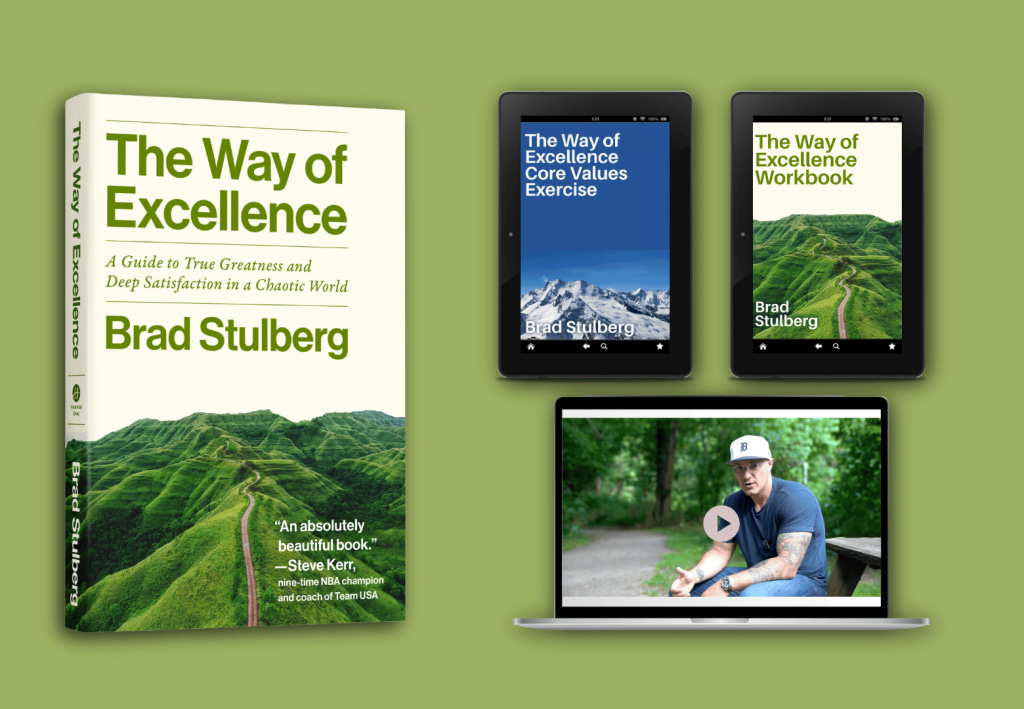
This was excerpted from The Way of Excellence. If you found this post valuable, you’ll love the book. Each and every chapter is packed with deep research, applicable insights, and resonant stories like the above.
It will help you take your game to the next level in a sustainable and deeply satisfying way, whatever your game may be. If you think you are going to get the book eventually, please pre-order today to receive it on your door-step on publication morning, help support my mission, AND get great bonuses right now.
The exclusive year-end values and goal selection exercise I use with all of my performance coaching clients.
An interactive workbook that can be used as an individual or team
A 90 minute masterclass including never-before released material on the creative process, back-stories from interviews and research, and more
A comprehensive reading list
And more
It’s an incredible value for the price of a single book. Don’t wait. Order the book today.
Step One: Pre-order here.
Step Two: Fill out this form with your order number to get your bonuses
Hey, great read as always. The AI music example really hit home. Makes you wonder if robots will ever appreciate the struggle, ha! What's your take on how we can quantify the value of the journey itself, beyond just the endpoint? Your always so insightful.
Great deep dive, Brad. Thank you!personally, I’ve learned that effort only feels rewarding when it’s tied to something that actually matters to me. I’ve chased goals that looked good on paper but were misaligned with my values - and no amount of “success” made them feel fulfilling.
And as you brilliantly described it, the moments that stayed with me weren’t the outcomes, but the stretch, the learning, the becoming. When the goal fits who you are, even the hard days feel meaningful. And when it doesn’t, the finish line feels strangely empty.